Want to find more information about Dinner's Done Personal Chef Service?
Call: 215-804-6438
Email: DinnersDonePA@comcast.net
Visit: www.DinnersDonePA.com
Sign up for my monthly e-newsletter: Click Here

COMMENTS ARE ALWAYS WELCOME! LET ME KNOW WHAT YOU THINK!

Showing posts with label In Defense of Food. Show all posts

Friday, April 26, 2013

How to Eat

I'm finally finishing up my "book report" on Michael Pollan's In Defense of Food.  Sorry it's taken so long.

I'll start with what may be a bit confusing.  We look at some other cultures and wonder how they are healthier than we are even though they seem to eat foods that would cause health problems for us.  The French, for example:
What nutritionism sees when it looks at the French paradox is a lot of slender French people eating gobs of saturated fat washed down with wine.  What it fails to see is a people with a completely different relationship to food than we have....They seldom snack, and they eat most of their food at meals shared with other people.  They eat small portions and don't come back for seconds.  And they spend considerably more time eating than we do....[T]he French consume fewer calories than we do, yet manage to enjoy them far more.
 
Serving sizes in restaurants in France are much smaller than they are in this country.  And that, in itself, is a psychological problem for us.  We have been raised to think of the amount that's given to us as the proper amount to eat.  In one study that Pollan describes, soup bowls were rigged to refill from the bottom.  Those who had those bowls, ate 73% more soup than those with regular bowls.  Some ate as much as a quart.  When asked what he thought of the soup, one subject with the bottomless bowl said, "It's pretty good; and it's pretty filling."  No kidding.

With that said, here are some of Pollan's tips on how to eat.
  • Pay more, eat less.  This tip is not for everyone (unfortunately).  In a country like ours, it should be.  But the point is, if you can afford to buy higher quality food, do it.  And in many cases--in our part of the country especially--that means eating fresh, local foods.  Does it cost more money?  In some cases, yes.  But aren't you really paying for it anyway even if you eat crappy, lower-cost, processed food?  You'll pay for it in medicines or doctor co-pays or higher insurance premiums.  Plus, if you spend more on your food, you'll be more likely to eat less--another healthy bi-product.  Americans spend less of our income on food than any industrialized nation.
In 1960 Americans spent 17.5 percent of their income on food and 5.2 percent of national income on health care.  Since then, those numbers have flipped:  Spending on food has fallen to 9.9 percent, while spending on health care has climbed to 16 percent of national income. 
  • Eat meals.  Duh, right?  No, not really.  I think I mentioned in another post how a recent study has shown that about 19% of American meals are eaten in the car.  Think about that for a minute.  That's a lot of meals on wheels.  Not to mention distracted drivers.  Family meals are so important--to kids, to family relationships.  (I won't give stats here--read my previous post for the details.)  The social value of eating together is becoming lost and will be completely if we don't change.  Another problem in this country is snacking.  We snack so we're not hungry for meals.  Foods are marketed to us to make it faster, easier, on-the-go and on and on.  It's actually pretty sad.
  • Do all your eating at a table.  Not a desk.  Not your lap.  Not balancing something on your dashboard. 
  • Don't get your fuel from the same place your car does.  "Gas stations have become processed-corn stations: ethanol outside for your car and high-fructose corn syrup inside for you."
  • Try not to eat alone.  Some of us don't have a choice, I guess.  But once again, the social aspect of eating is so important to who we are.  Not only do we lose that part of a meal, but we usually eat more when we're alone. 
  • Consult your gut.  I eat way too fast.  It's really something that I try to work on, but I've done it for so long, it's hard to change it.  And I'm sure that it causes me to eat more than I should.  It takes 20 minutes for your stomach to tell your brain that it's full.  When you scarf down your food in half that time, you don't realize that you're getting full and overeat.  Pollan tells of a group of French people who were asked when they stop eating.  The answer: "When I'm full."  What did Americans say?  "When I finished what was on my plate."  or "When the food was gone."
Serve smaller portions on smaller plates; serve food and beverages from small containers (even if this means repackaging things bought in jumbo sizes); leave detritus on the table--empty bottles, bones, and so forth--so you can see how much you've eaten or drunk; use glasses that are more vertical than horizontal (people tend to pour more into squat glasses); leave healthy foods in view, unhealthy ones out of view; leave serving bowls in the kitchen rather than on the table to discourage second helpings. 
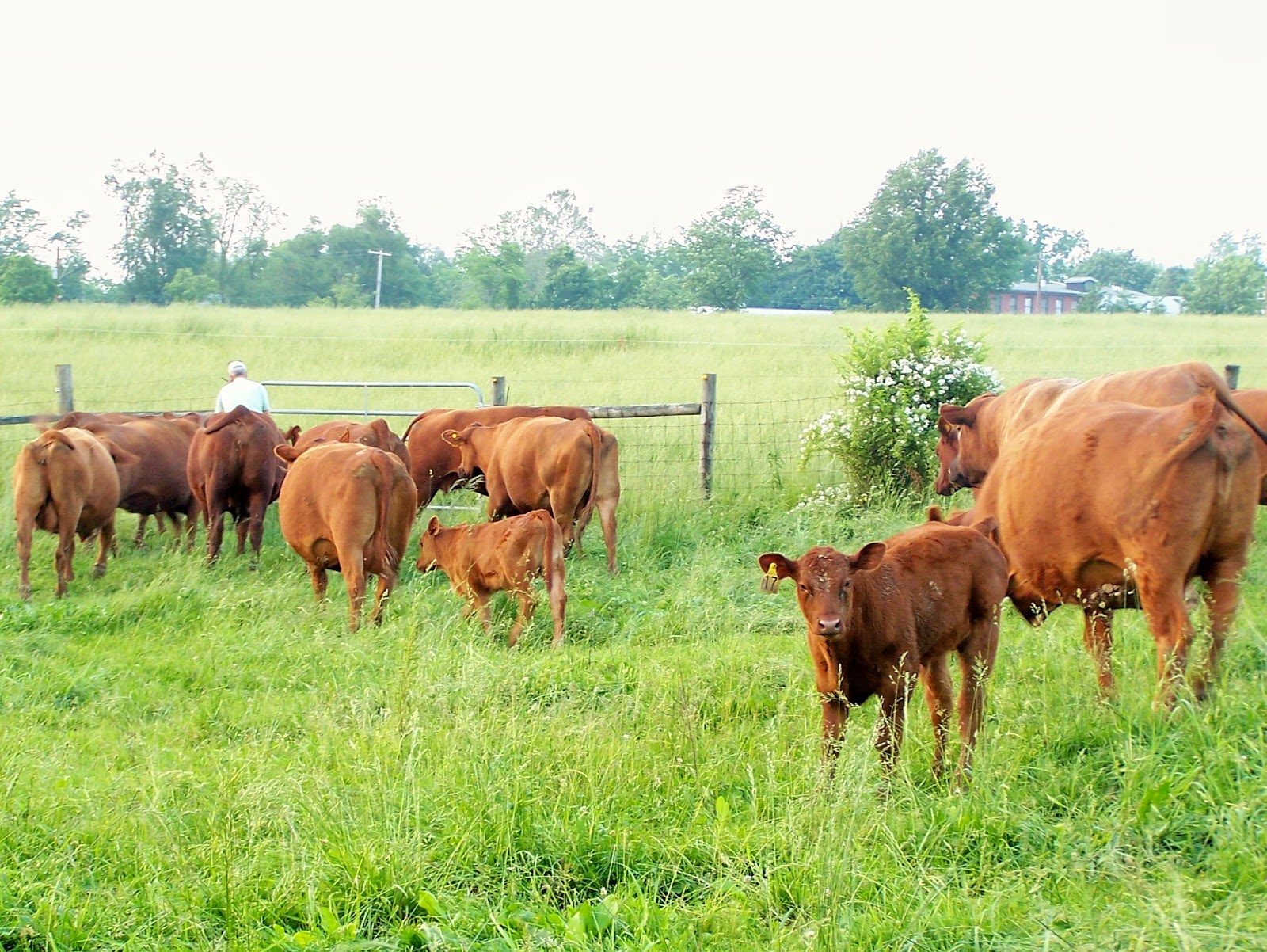
  • Eat slowly.   With this tip, Pollan doesn't only mean what I wrote of above, but to be knowledgeable about food in the way of the Slow Food movement.  This was started in the '80s when fast food came to Rome and started to threaten what food was all about in Italy.  It tries to combat industrialized foods that are engineered for us to eat fast, on the go.  If we knew what went into that fast food burger--the slaughterhouse, the grain-fed animals, the artificial flavorings, etc--I'm not sure we'd want to eat it.  Knowing that our burger is from grass-fed cattle in a beautiful pasture helps us enjoy our food even more. 
  • Cook and, if you can, plant a garden.  I recently was part of a panel at a local daycare center that had a program about child nutrition and eating.  I told them how my son, Jake, is a great eater and is extremely healthy.  Why?  I believe he eats more "real" food than many of his peers.  But I think one of the reasons he does eat so well is that he was raised appreciating food--going to farmers' markets, growing things in our garden, being a CSA member.  At the risk of sounding sappy, he has learned to commune with nature and with those who raise our food.  He understands how cool it is to pick something from the garden and turn it into a meal.  Too many kids think that beans come from the freezer section at the supermarket and not a field.  And cooking helps us with that relationship with food.  As Pollan explains, there are studies that show that cooking tomatoes in olive oil allows the tomato's nutrients to better enter our bodies.  If you cook, though, you just know that cooking tomatoes with olive oil is a good idea.  It tastes good!
So that's it.  Maybe I took too long going through all this stuff, but I really think it's so important.  If we don't change the way we eat, we will lose so much--our health; our relationship with each other, with those who produce wonderful food, and with the food itself.  Read In Defense of Food.  And try to make some of these changes--appreciate and enjoy your food!
     

Wednesday, April 17, 2013

More Tips for Eating

Here are some more tips about how to eat from Michael Pollan's In Defense of Food.  These suggestoins not only give you ideas of how to eat a more healthy diet, but it steers you away from the Western diet that is--in many ways--literally killing us.  If enough of us really ate this way, maybe we could change the food culture in this country and reverse those health problems that the Western diet has brought upon us.
  • Eat mostly plants, especially leaves.  There are lots of good reasons to eat plants.  They give us vitamins, antioxidants, fiber, omega-3 fatty acids.  Oh, and they taste good.  The key is to eat a variety of plants to fill our bodies with a variety of nutrients, which help to make us healthy in a variety of ways.  Thomas Jefferson suggested eating meat as more of a "condiment for the vegetables".
Because plant foods--with the exception of seeds--are less energy dense than most of the other things you might eat, by eating a plant-based diet you will likely consume fewer calories (which is itself protective against many chronic diseases).  The seed exception suggests why it's important to eat more leaves than seeds; though unrefined seeds, including whole grains and nuts, can be very nutritious, they're high in calories, befitting their biological role as energy-storage devices.  It's only when we begin refining plant seeds or eating them to the exclusion of the rest of the plant that we get into trouble.

  • You are what what you eat eats too.  I love that one.  It's the whole food chain idea again.  If the animals we eat eat healthy plants, they'll be healthy.  And so will we.  For example, most of our food animals were made to eat grass, but they're being fed grains--it's cheaper and gets them fatter faster.  But it also makes them sick.  So what has to happen?  They need to get antibiotics.  Some food animals--like poultry and pigs--do OK on grains.  But they are healthier--and so are we--when they have the opportunity to eat grass.  Pollan does make the point that,
"Free range" doesn't necessarily mean the chicken has had access to grass; many egg and broiler producers offer their chickens little more than a dirt yard where nothing grows.  Look for the word "pastured."  And in the case of beef, keep in mind that all cattle are grass fed until they get to the feedlot; "grass finished" or "100% grass fed" is what you want.

  •  Eat like an omnivore.  The more variety of foods you eat, the better chance you'll receive the best nutrition possible for your body.
  • Eat well-grown food from healthy soils.  Pollan makes the point that he could have said, "Eat organic".  But there are lots of great farmers and producers who are essentially organic, but just have not gone through the fairly lengthy process of being certified as such.  In addition, there are processed foods that are labeled "organic", but are not much better than other processed foods.  They're simply processed using organic ingredients.  He talks about how if Coca-Cola used organic corn for their high-fructose corn syrup, would Organic Coke be good for you?  Ideally, find foods that are organic AND local.
  • Eat wild foods when you can.  Wild greens tend to have more omega-3 fatty acids than their domesticated counterparts.  Wild game usually has less saturated fat and more omega-3s than domesticated animals.  This is one of his suggestions that seems to be a little bit hard to follow.  I suppose seafood is the one place that you usually have your choice.
  • Be the kind of person who takes supplements.  I found this suggestion interesting. 
We know that people who take supplements are generally healthier than the rest of us, and we also know that, in controlled studies, most of the supplements they take don't appear to work.  Probably the supplement takers are healthier for reasons having nothing to do with the pills:  They're typically more health concious, better educated, and more affluent.  So to the extent you can, be the kind of person who would take supplements, and then save your money.

  •  Eat more like the French, or the Italians, or the Japanese, or the Indians, or the Greeks.  His point here is to think about eating traditional cuisines--food traditions from cultures that have been healthy for, well, forever.  In many cultures, food is pretty much the central focus of their lives--it's their livlihood, there are religious connections, it helps them acclimate to their climate, it brings people together. 
  • Regard non-traditional foods with skepticism.  Pollan uses soy as a example.  Americans eat more soy products than ever, but because of the non-traditional processing of them, we get very little of the nutrition that the soy-heavy cuisines of Asia get from the traditional ways they eat soy. 
  • Don't look for the magic bullet in the traditional diet.  We look at the Mediterranean diet or Asian diets or whatever and try to figure out what is it about that diet that makes those people so healthy?  Lots of fish?  Greens?  Garlic?  Bottom line is that it's not any one of those things.  It's the combination of foods and nutritents that create the health benefits.  Sort of the opposite of the Western diet.
  • Have a glass of wine with dinner.  As studies have recently shown, people who moderately drink alcohol live longer, have a lot less heart disease and are generally healthier than those who do not drink at all.  Drinking a little each day is much better than drinking a lot on the weekend.  And drinking with food is better than without. 
Also, a diet particulary rich in plant foods, as the French and Mediterranean diets are, supply precisely the B vitamins that drinking alcohol depeletes.  How fortunate!

 
Food for thought, as it were.  One more entry about this book to go.  Then we can get to work changing the way we eat!


Monday, April 15, 2013

What is Food?

In his book, In Defense of Food, Michael Pollan gives some tips about what he thingks we should eat to avoid the pitfalls of the Western diet.  Many of them make a lot of sense.  Admittedly, though, some just don't seem feasible to do all the time.  I mean, who doesn't want a Tastykake or a White Castle cheeseburger once in a while?

So I think that using his tips is a great guideline for eating healthy, tasty foods.  Try to do it as much as you can and you're in much better shape than most of the folks in this country.

Here are some of Pollan's suggestions:
  • Don't eat anything your great grandmother wouldn't recognize as food.  This will help you distinguish between food and food products.  He also suggests a related thought: Don't eat anything incapable of rotting.  (Except honey, I assume.)
  • Avoid food products containing ingredients that are A) unfamiliar, B) unpronounceable, C) more than five in number, or that include D) high-fructose corn syrup.  Pollan says that each of these in themselves aren't that harmful, but they're all a mark of highly processed foods.  There are exceptions to some of the rules, I think.  I make trail mix that has way more than 5 ingredients, but you get the idea.
  • Avoid food products that make health claims.  Pollan writes: "For a food product to make healthy claims on its package it must first have a package, so right off the bat it's more likely to be a processed than a whole food."  This is a really big problem for people looking to eat more healthy foods, but aren't informed.  The FDA's rules allow food companies to make these claims in any way they want (like big print with disclaimers in microscopic print).
The American Heart Association currently bestows (for a fee) its heart-healthy seal of approval on Lucky Charms, Cocoa Puffs, and Trix cereals, Yoo-hoo lite chocolate drink, and Healthy Choice's Premium Caramel Swirl Ice Cream Sandwich--this at a time when scientists are coming to recognize that dietary sugar probably plays a more important role in heart disease than dietary fat.
 
  • Shop at the peripheries of the supermarket and stay out of the middle.   I've always given this suggestion to people looking to find more healthy food when shopping.  Of course, it's not fool-proof.  Just check out the neon-colored kid's yogurt in the dairy case or that fake caramel dip in the fruit section. 
  • Get out of the supermarket whenever possible.  Shop at farmers' markets or a local butcher shop.  Better yet, join a CSA (Community Supported Agriculture) farm and get fresh produce all season long.  Produce--conventional or organic--in a supermarket travels an average of 1600 miles from field to your plate.  From the moment it's picked most produce starts to lose taste and nutrition.  So the stuff at your local farmers' market is better tasting and better for you (and it helps our local economy).  And having that fresh stuff should make you want to cook it.
Cooking is one of the most important health consequences of buying food from local farmers; for one thing, when you cook at home you seldom find yourself reaching for the ethoxylated diglycerides or high-fructose corn syrup.
 
Pollan writes about how the shorter the food chain, the better:
Only when we participate in a short food chain are we reminded every week that we are indeed part of a food chain and dependent for our health on its peoples and soils and integrity--on its health....Depending on how we spend them, our food dollars can either go to support a food industry devoted to quantity and convenience and "value" or they can nourish a food chain organized around values--values like quality and health.  Yes, shopping this way takes more money and effort, but as soon as you begin to treat that expenditure not just as shopping but also as a kind of vote--a vote for health in the largest sense--food no longer seems like the smartest place to economize.

Not much more I can say in addition to that.  Mr. Pollan seems to have hit it right on the head.

More tips next time.


Wednesday, April 10, 2013

Escape from the Western Diet

I take the title of today's post from Michael Pollan's title for one of the sections in his In Defense of FoodAnd it sort of is the crux of the problem that has created our health problems.

As we've seen, those who eat the Western diet are prone to all sorts of medical problems that could be avoided by eating differently--heart disease and diabetes being the most prominent.  I guess the question is why we don't eat more "real" food and less processed, Western diet food?

Part of it is today's food industry.  They continue to push low-fat and low-carb products.  They continue to add omega-3 and antioxidants to products.  Sounds good, but the bottom line is that this just further processes the things they want us to eat.  And draws them further and further from being
real food.

And it may seem cynical, but the health care industry benefits, too.  As I wrote last time, it's apparently easier to create treatments for these diseases than to change the way we eat and prevent them altogether.  Easier for us to get treated than to avoid it, too.

More from Pollan:
...[I]nstead of worrying about nutrients, we should simply avoid any food that has been processed to such an extent that it is more the product of industry than of nature. 
 
Sound sensible enough, writes Pollan:
...until you realize that the industrial processes have by now invaded many whole foods, too.  Is a steak from a feedlot steer that consumed a diet of corn, various industrial waste products, antibiotics, and hormones still a "whole food"?  I'm not so sure.  The steer has itself been raised on a Western diet, and that diet has rendered its meat substantially different--in the type and amount of fat in it as well as its vitamin content--from the beef our ancestors ate.  The steer's industrial upbringing has also rendered its meat so cheap that we're likely to eat more of it more often than our ancestors ever would have.  This suggests yet another sense in which this beef has become an industrial food: It is designed to be eaten industrially, too--as fast food.
 
Ugh.

It's a whole change of thinking that will allow us to escape the Western diet.  It will cost more--in money and time--but we end up paying for it eventually anyway in the form of prescriptions and doctor co-pays.  So why not pay for great, local, healthy foods now, take the time to prepare it in a way that will highlight the taste.  And sit down (as a family, is a good idea) and ENJOY our food.  SAVOR it. 

According to a study noted in the book, Americans spend less than 10% of their income on food.  (Italians and French spend 14.9%, Spanish spend 17.1%.)  They also spend less than half an hour a day preparing food and less than an hour a day enjoying it.  (Much less than 50-60 years ago.)  I recently saw a study that says that about 19% of American meals are eaten IN THE CAR!

This is ridiculous.  Family meals are known to bring families closer together.  Kids who eat a majority of their meals as a family do better in school, are less likely to mess around with alcohol and drugs and get along better with their parents.

Yes, it's hard.  So few of us have the time to prepare a meal, let alone time to sit down as a family to eat it.  That's a whole other culture change that needs to be made.  But there are healthy, delicious meals that can be made quickly.  Take time to make meals ahead of time, so they can be put on the table quicker.  Hire a personal chef (I know a good one!) to use fresh ingredients to make meals for your family that you can put on the table in a matter of minutes and clean up in even less time. 

There are ways to do this.  You just have to want to do it.

Monday, April 8, 2013

Something Seedy in our Diet

Here's some more of my "book report" about Michael Pollan's In Defense of Food.

As I wrote in the last post about Pollan's book, we are eating loads of corn and soy (among other things) to our health's detriment.  The thing is we should be eating much more leaves than seeds to get the most nutrition from plants. 

Green plants give us much of the omega-3 fatty acids (that we often associate with fish).  Leaves make these fatty acids through photosynthesis.  We need them because, well, we can't go through photosynthesis--or any other process--to produce them ourselves.  And they are important: they've been found to help our brains, eyes, metabolism, inflammation and on and on.  What we get from seeds are omega-6, which isn't bad, we just don't need so much of it.

Pollan writes:
It helps to think of omega-3s as fleet and flexible, omega-6s as sturdy and slow.  Because the two fatty acids compete with each other for space in cell membranes and for the attention of various enzymes, the ratio between omega-3s and omega-6s, in the diet and in turn in our tissues, may matter more than the absolute quantity of either fat.  So, too much omega-6 may be just as much of a problem as too little omega-3.
 
So by eating a Western diet, that ratio is all screwed up in our bodies.  The same goes for our food animals, which often are not being fed the leaves that they were meant to eat.  Their diet is replaced with grains, which lowers the omega-3s in our meat, dairy, eggs, etc and increases the omega-6s.  For example, that's why grass fed/finished beef is so much healthier than grain-fed.

Pollan uses the Japanese as a comparison to Americans.  The Japanese take in huge amounts of omega-3s (much of it from fish) and have amazingly low rates of cardiovascular disease--even though they smoke at high rates and have high blood pressure.  Americans, on the other hand, take in about a third of omega-3s and have about 4 times the rate of death from heart disease.  Hmm...  So even using omega-3 supplements in our diets doesn't really do too much good unless we lower the omega-6s we're ingesting.

But how do we know this?  Who is supposed to tell us to eat fish or greens to be healthy?  For most of human history, it was our culture, our ethnicity, those traditional foods that were raised or caught where we or our ancestors lived.  Now where do we look for help?  The health care industry.  How's that working out?

More from Pollan:
Medicine is learning how to keep alive the people whom the Western diet is making sick.  Doctors have gotten really good at keeping people with heart disease alive, and now they're hard at work on obesity and diabetes.  Much more so than the human body, capitalism is marvelously adaptive, able to turn the problems it creates into new business opportunities: diet pills, heart bypass operations, insulin pumps, bariatric surgery.  But though fast food may be good business for the health care industry, the cost to society--an estimated $250 billion a year in diet-related health care costs and rising rapidly--cannot be sustained indefinitely.
 
He goes on to write how an American born in 2000 has a 1 in 3 chance of getting diabetes sometime in his life--even more if he's African-American or Hispanic-American.  Being diagnosed with diabetes takes about 12 years off your life and costs $13,000 in medical costs.  Someone without diabetes has about $2500 in those costs.  Diabetes is becoming more of the norm in the US thanks to the Western diet.  As Pollan writes: "Apparently it is easier, or at least a lot more profitable, to change a disease of civilization into a lifestyle than it is to change the way that civilization eats."

Tuesday, April 2, 2013

Complexity vs. Simplicity

I'm continuing my "book report" about Michael Pollan's In Defense of Food today with his discussion about how breaking down things into component parts is not always the greatest thing--especially for our food and our health.

He talks about how for simplicity's sake (yield, shipping, shelf-life, etc) half of America's commercially grown broccoli, for example, is one high-yield variety.  The great majority of chickens raised in this country are the same hybrid.  More than 99% of turkeys raised here are the same
variety.

Why does this matter?  Says Pollan:
With the rise of industrial agriculture, vast monocultures of a tiny group of plants, most of them cereal grains, have replaced the diversified farms that used to feed us.
 
Think about what a typical farm grew and raised 100 years ago.  A huge amount of different fruits, vegetables and livestock.  Now, things have changed, says Pollan:
 This simplification of the agricultural landscape leads directly to the simplification of the diet, which is now to a remarkable extent dominated by--big surprise--corn and soybeans.  You may not think you eat a lot of corn and soybeans, but you do: 75 percent of the vegetable oils in your diet come from soy (representing 20 percent of your daily calories) and more than half of the sweeteners you consume come from corn (representing around 10 percent of daily calories).
 
Yikes. 

Much of the corn and soy crop goes into feed for the animals we eat--simplifying their diets, which is unhealthy for them.  But our health is being dictated by the amount of corn and soy in our foods.  Again, Pollan writes:
...Today corn contributes 554 calories a day to America's per capita food supply and soy another 257.  Add wheat (768 calories) and rice (91) and you can see there isn't a whole lot of room left in the American stomach for any other foods....Today these four crops account for two thirds of the calories we eat.  When you consider that humankind has historically consumed some eighty thousand edible species....this represents a radical simplification of the human diet.

The problem is that humans are omnivores.  We are built to get our nutrition from a wide variety of foods, not just these four.

Another problem with industrial farming is a loss in nutrition in the crops themselves.  The USDA has shown that 43 crops they have traced since the middle of the 20th Century have decreased nutrition. 
 ...You have to eat three apples to get the same amount of iron as you would have gotten from a single 1940 apple, and you'd have to eat several more slices of bread to get your recommended daily allowance of zinc than you would have a century ago.
 
Industrial fertilizers are part of the problem.  Crops grow quicker and don't have the time to build up the nutrients they would if they were grown naturally.  They also give the plants an easier time to get the nutrients they need, so their roots aren't as deep and can't reach down into the soil where the essential minerals dwell. 

This is a big issue and way too much for me to write about here (read the book).  But you get an idea of how things like this are all intertwined with our food and our health.  More later.
  

Monday, March 25, 2013

Relationship With Food

Here's some more from Michael Pollan's book, In Defense of Food.

One of the major points that he makes is something that really resonates with me.  It's the idea that everything is connected--the earth, our food, people, animals, our health.  With the growth of processed foods, these relationships are removed from our eating--we're just ingesting instead of living in that natural circle that we were meant to be a part of.  And nowhere does this show itself than in our health.

Pollan writes:
Health is, among other things, the product of being in these sorts of relationships in a food chain....If the soil is sick or in some way deficient, so will be the grasses that grow in that soil and the cattle that eat the grasses and the people who drink the milk from them.
 
As I said, we were built to have these relationships with our food and the soil.  We, and other animals, are wired to recognize both the good and bad in the foods that we are considering.  These relationships have been fostered for generations--since we were out hunting and gathering.  We know when a fruit or vegetable is ready to eat--we know the color or the scent or the taste.  The plant is telling us that it is ready to spread it's seeds by being ripe.  Put seeds inside a juicy peach or apple and some animal will eat it and spread the seeds.  It just so happens that this is also the time when the most nutrition can be gotten from a plant. 

But in the Western diet, our senses are being fooled by artificial sweeteners or colors.  The processing of foods also causes us confusion.

Pollan tells the story of refined flour.  How the development of rollers, which took the place of stone grinders, removed the nutritious parts of the wheat from the flour.  The now-white flour looked great, but didn't give any kind of nutrition, as opposed to stone-ground.  Pollan says:
Wherever these refining technologies came into widespread use, devastating epidemics of pellagra and beriberi soon followed.  Both are diseases caused by deficiencies in the B vitamins that the germ had contributed to the diet. 
 
So what came next?  The fortifying of flour with these missing vitamins in the 1930s.  And in 1996, the government saw that our diets were low in folic acid, so millers were ordered to add it to flour.  And on and on it goes.  "Real" food becomes "Frankenstein" food--a bunch of components put together.  This is great, except it ignores the idea that "A whole food might be more than the sum of its nutrient parts."  Nutrients occurring naturally in, say, an apple, work in tandem and do more good than each of the nutrients taken separately. 

Next time, we'll talk about corn and soy--things we eat way too much of.

Thursday, March 21, 2013

More from Pollan

I'm back with a bit more from In Defense of Food by Michael Pollan.  In previous posts, I've written a kind of book report about this book.  I highly recommend reading it--I'm just touching on the highlights.  It really makes you change the way you look at the things you're eating.

As I mentioned at the end of my last post, Pollan goes into great detail of how the Western diet is the main cause of diseases such as heart disease, diabetes, etc that are running rampant in this country. 

He tells of an study in Australia in 1982 where a group of 10 middle-aged, overweight and diabetic Aborigines that were living in Western Australia agreed to be a part of an experiment.  They moved from their "civilized" homes to the homes of their ancestors--back to the bush.  In a nutshell, after 7 weeks, all had lost weight, had lower blood pressure, lower triglycerides and increased omega-3 fatty acids.  In short, they became much healthier in an amazingly short amount of time.

Pollan writes:
What we know is that people who eat the way we do in the West today suffer substantially higher rates of cancer, cardiovascular diseases, diabetes, and obesity than people eating any number of different traditional diets.  We also know that when people come to the West and adopt our way of eating, these diseases soon follow, and often, as in the case of the Aborigines and other native populations, in a particularly virulent form....[W]hen one Western disease arrived on the scene, so did most of the others, and often in the same order: obesity followed by type 2 diabetes followed by hypertension and stroke followed by heart disease.
 
Welcome to our world. 

So why does this happen?  Basically, it's the processing of most of our foods.  During processing, food is made to last longer so it can be shipped and sit on store shelves.  But to do this, nutrients--the things that bugs and other pests are seeking out--are removed. 

The interesting thing is that studies show that there is not one ideal diet to follow.  There are cultures that eat virtually all meats and dairy.  There are those that eat a majority of seafood and little dairy.  Some have lived on a mostly vegetarian diet while others eat very little green vegetation.   Yet all these cultures and traditions result in people much healthier than we are.  The common thread that runs through all of these diets--the consumption of fresh foods, whether animal or plants, that are high in nutritional value. 

Again, Pollan:
The human animal is adapted to, and apparently can thrive on, an extraordinary range of different diets, but the Western diet, however you define it, does not seem to be one of them.
 
Next time, thinking differently about our food.

Thursday, March 14, 2013

More Defense

I'll continue with more of my "book report" on Michael Pollan's In Defense of Food

So one of Pollan's main points is that nutritionism rules how and what we eat these days.  We're more worried about the antioxidants and low-fat labels on foods than on what the food really is.  He makes the point that these nutrients that are added to so many foods, often don't really do their job as they do in nature.  They need the relationship with other chemicals and nutrients in the food to create the benefits that they were intended to have.

And often, these "nutritional" way of eating--low-fat, for example--sometimes lead to other problems.  Pollan writes:
Like most of us, they [researchers] assumed that a bad outcome like heart disease must have a bad cause, like saturated fat or cholesterol, so they focused their investigative energies on how these bad nutrients might cause disease rather than on how the absence of something else, like plant foods or fish, might figure in the etiology of the disease.  Nutrition science has usually put more of its energies into the idea that the problems it studies are the result of too much of a bad thing instead of too little of a good thing.
 
Of course, other factors come into play with regard to these diseases--social class for example.  Poor people don't often have the ability to exercise or eat fresh vegetables or fish.  Many only have access or the money to buy processed foods--causing a problem of obesity even in those who are most in need of food.  This, then leads to diabetes and heart disease in many cases.

This segues into Pollan's next major discussion.  Those of us who eat a Western Diet are the ones who end up with these diseases.  Next time, I'll go into a little more about that.

Tuesday, March 12, 2013

Defense, cont.

So I wrote yesterday about how the 1973 FDA ruling that foods can be changed without being labeled "imitation" opened the floodgates for food producers to add all sorts of "healthy" ingredients to our food. 

One of the most prevalent was the perpetuation of the fear about fat--that it causes heart disease, stroke, etc.  Recent studies, however, have shown that for the most part, this is not the case.  Michael Pollan writes:
Only one study has ever found "a significant inverse association between poly-unsaturated fat intake and CHD [coronary heart disease]."  Let me translate:  The amount of saturated fat in the diet may have little if any bearing on the risk of heart disease, and evidence that increasing polyunsaturated fats [such as margarine] in the diet will reduce risk is slim to nil.
 
In addition, there's little proof that dietary cholesterol leads to CHD risk.  Some say that reducing fat in the diet leads to weight loss, but again, there's little to support this claim as well.

If that theory were correct, when we're all trying to reduce our fat intake, why the rampant spread of heart disease in this country?  According to Pollan, you need to look back in time.
...during the decades of the 20th Century when rates of heart disease were rising in America, Americans were actually reducing their intake of animal fats (in the form or lard and tallow).  In place of those fats, they consumed substantially more vegetable oils, especially in the form of margarine, sales of which outpaced butter for the first time in 1957. 
 
Between the end of World War II and 1976, animal fat consumption in the US dropped greatly, while fats from seed oils almost doubled.  Yet, there were more people having heart attacks.  Hmm.

Heart disease dropped greatly during WWII and Pollan hypothesizes that it's because of the war's affect on the availability of meat, butter and eggs--not to mention sugar and gasoline being rationed.  Americans were eating less of everything--except fish, interestingly.  And they got more exercise because of the gas rationing.  A theory, but an interesting theory nevertheless.

Probably the thing I agree with the most in Pollan's book is the fact that industrial food production has been the downfall of our health in this country--with thanks to the government's nutrition guidelines.  Again, he writes:
The whole of the industrial food supply was reformulated to reflect the new nutritional wisdom, giving us low-fat pork, low-fat Snackwell's and all the low-fat pasta and high-fructose (yet low-fat!) corn syrup we could consume....Oddly, Americans got really fat on their new low-fat diet....

All this helped to change the way Americans ate--focusing on the components of the things they were eating rather than the experience of eating--the taste, the pleasure, the healthful whole food.  We want to eat antioxidants and beta-carotene instead of fruit and fish.   

I'll talk about that a little more next time.
 

Monday, March 11, 2013

In Defense of Food

I first heard of Michael Pollan while organizing a screening of the film Fresh a few years ago.  There were a lot of great points made by a lot of interesting people in that film, but his stood out to me and made me think about not only how important eating "real" food is, but how it impacts so many parts of our lives--the environment, the economy, health care, etc.

I recently read his 2008 book, "In Defense of Food" and it was eye-opening.  If you are at all interested in how food can affect our lives and health, then this is a must read. 

In my mind as I read the book, I was going to write a blog entry about it.  But there are so many interesting and worthwhile topics that he discussed in the book, it's hard to just choose a couple.  So, if you'll indulge me, I'll revert back to my junior-high-book-report-writing days and try to summarize what Pollan's book is all about.  It'll take more than one blog entry, but hopefully, it'll whet your appetite (pun intended) to read the book.

I admit that after reading the book, I look at everything that I eat in a different light.  His ideas are thought-provoking and make a lot of sense.  The last parts of the book are his tips and suggestions for how to eat.  Some of them are things that I already do--and maybe should do more of.  Some, admittedly, are just not practical--for me, at least.  I want a Coke or a Tastykake once in a while.  But just getting people to think about these things will help to change the food culture in this country, which is at the root of our eating problems.

Part of what Pollan tries to do in the beginning of the book is to define what "food" is.  Food is not necessarily anything we eat.  In his definition, we eat a lot more than "food".  He writes:
But I contend that most of what we're consuming today is no longer, strictly speaking, food at all, and how we're consuming it--in the car, in front of the TV, and, increasingly, alone--is not really eating, at least not in the sense that civilization has long understood the term.
 
Eating is so much more than just ingesting food.  It's about pleasure, communion, family, culture.  I recently wrote about how important eating as a family can be to the development of a family--especially the children.  (Click here for that post.)

But despite how we in this country are eating--filling ourselves with non-nutritious foods on the run--we seem to want to eat healthily.  Pollan talks extensively about how we have become "a nation of orthorexics: people with an unhealthy obsession with healthy eating."  An interesting thought, huh?

Think about it.  We are inundated by ads for weight loss, nutritional supplements, vitamins, fish oil, on and on and on.  Walk through a supermarket and look at all the items with some sort of nutritional claim--whole grain, fortified with vitamins and minerals, low-fat, low-sodium, added antioxidants, etc. 

This is "nutritionism".  The idea that eating is simply taking in nutrients--with little or no regard for anything else.  And our country's obsession with this idea has helped it to grow. 

Pollan tells about a 1938 act that required the word "imitation" on any food that was in any way changed from the traditional or common form of the food.  Milk with added vitamins and the like.  If anything was changed, it was "imitation".  But the FDA in 1973, repealed this rule while passing new food labeling laws.  Now, as long as the food was not deemed "nutritionally inferior" to the "real" version, it was not "imitation". 

With that, the regulatory door was thrown open to all manner of faked low-fat products:  Fats in things like sour cream and yogurt could now be replaced with hydrogenated oils or guar gum or carrageenan, bacon bits could be replaced with soy protein, the cream in "whipped cream" and "coffee creamer" could be replaced with corn starch....
 
Not imitation in the government's eyes, but imitation nonetheless.  And in most cases, less healthy, depsite what is told to us by the producers of these items.  It was the beginning of the confusion of food labels that is meant to draw us in with all those promises.