Want to find more information about Dinner's Done Personal Chef Service?
Call: 215-804-6438
Email: DinnersDonePA@comcast.net
Visit: www.DinnersDonePA.com
Sign up for my monthly e-newsletter: Click Here

COMMENTS ARE ALWAYS WELCOME! LET ME KNOW WHAT YOU THINK!

Showing posts with label New York Times. Show all posts

Wednesday, October 3, 2012

Beet It!

Beets.  It seems that people either love them or hate them.  Or they never have tried them. 

Now, I wouldn't say that I'm a huge beet fan.  I don't eat them all that much.  But maybe I should.

Beets are incredibly healthy.  They are known to fight heart disease, birth defects and cancer (especially colon cancer).  They are full of good things like fiber, folate, potassium, vitamin C and more.  Many consider the beets used in borcht to be a factor why so many of those century-old Russians live so long.

But the pigments that give beets their intense color (whether red or yellow are the real health stars.  These pigments, called betalains, are major antioxidants and anti-inflammatories.  Interestingly, only about 10-15% of people are "betalain responders"--meaning that only some of us have the capacity to absorb and metabolize these compounds enough to get the full benefit.  It's worth the try, though.

There are all sorts of ways to prepare beets.  You could go Dutchie and pickle them.  I love them that way.  Their flavor intensifies when they're roasted.  You can even eat them raw.  And don't forget the greens.  Beet greens are very flavorful and so easy to prepare--just prepare as you would chard or spinach.

Here's a recipe from the New York Times for a beet salad that uses both the beet and their greens.  However you try them, enjoy their sweet taste and the great health benefits that you get from these tasty veggies.

Monday, May 7, 2012

Be Strong to the Finish

Spinach.  It's one of the most healthy foods you can find--filled with loads of vitamins (especially A & C) and extremely high in antioxidants.  It's also considered to be high in folic acit, iron and calcium among many other nutrients.

But to some, spinach is just an ugly blob of goo sitting on their plate.  It doesn't have to be that way. 

Spinach does not have to be cooked very much (many like to eat it raw) and it only takes minutes to prepare by sauteeing, steaming, wilting, etc--making it a great weeknight side dish. 

Mark Bittman of the New York Times has come up with tasty and easy ways of putting more of this great veggie on your dinner plate. 

While there are many ways of cooking spinach, Bittman uses wilting, steaming, braising and super-slow cooking to create 12 distinct, but simple dishes.  Read about them here.

Fresh spinach should be appearing soon in your local farmers' market (if it hasn't already), so pick up a bunch or two and try these recipes--or your own favorite!

Thursday, March 29, 2012

Preserved Lemons

One of the classic flavors in many Middle Eastern, North African, Cambodian and Indian food is the preserved lemon.

Originally used as a way to keep lemons long past the time they were fresh, lemons are basically pickled in a strong brine of salt, sugar, water and lemon juice.  (Sometimes other flavors like cinnamon, cloves, peppercorns or other spices are added.) 

The flavor is sweet, salty, sour and bitter all at the same time.  It pairs great with the strong flavors of the cuisines listed above, but you could use them in any dish that you think might work with them.  The rind and/or the pulp may be used to flavor the dish and they can be sliced, diced or cut in whatever way works best for the dish you're making.

They aren't hard to make, but the problem is, they can take at least 3 weeks to make depending on the recipe you have.

But Melissa Clark of the New York Times gives a way to make this unusual flavoring in just about 10 minutes in this article.  She also includes a link that tells how you can make them the traditional way. Either way, they last a long time in the fridge, so you'll have plenty of time to try out all sorts of new recipes on your family!

Wednesday, February 1, 2012

Root, Root, Root for the Home Team

We all know that eating locally is great--especially in our area with all the great farms and farm markets around.  It gives us fresher, more nutritious, more delicious produce than we could ever find in a supermarket.

But we also know that in the dead of winter (yes, this is winter despite the spring-like weather), it's hard to eat locally grown produce.  No tomatoes or cucumbers around here these days.  So if we can't necessarily eat locally, we can eat seasonally.  And this time of year, that often means root vegetables.

Supermarket tomatoes, for example, grown in California or Mexico or wherever, taste lousy because tomatoes just don't ship well.  But root veggies, whether they're grown locally or not, will not lose their freshness for a long time.

Carrots, parsnips, beets, celeriac and other root veggies may not have gained popularity until recently (and for some, haven't gotten that far yet).  But don't dismiss them--especially roasted where they get browned and so sweet. 

The cool thing about them, as NY Times food columnist, Mark Bittman, writes, is that root veggies can be used virtually interchangeably.  You may have to adjust cooking times, but you can use parsnips in a recipe that calls for carrots or turnips in place of potatoes, etc.  Check out Bittman's article about root veggies and be sure to click the link that takes you his recipes. 

Wednesday, December 14, 2011

Finger Food Help

This time of year, most of us are trying to find quick and easy foods for entertaining--whether it's for a party or for when people unexpectedly drop in.

Yes, having cheese and crackers on hand is helpful.  But doing just a little bit more can make a great impression--and create some tasty treats.

The New York Times' Mark Bittman always seems to come up with some great templates for how to make delicious food (see some of the other items I've posted in the past using his articles). 

This time, Bittman lays out a flow chart for creating great finger food with little prep time.  Most of the ingredients he uses might just be in your pantry or fridge when you need them. 

He divides good finger food into 3 parts: The Base--crackers, celery, etc that will hold other ingredients; The Spread--something to spread on The Base that will be flavorful and hold The Finishing Touch--something with flavor and texture.

Check out his chart here.  Then just wait for guests to show up!

Thursday, October 6, 2011

Waste Not, Want Not


Everyone has it happen to them.  You go through the fridge once in a while (I try to do it every week) and you end up throwing away a bunch of stuff.  The red pepper you forgot was in the bottom of the crisper drawer.  The container of sauce that you were sure you were going to use for something.  Wasting food is an unfortunate fact of life in this country.

That's the drawback of living in a country where things are so plentiful.  Think of other things you throw away: the tops of carrots, citrus rind, potato peels, corn cobs and more--all of which could be used as ingredients in delicious food.

Leaves of carrots, celery and fennel can be used to flavor sauces or as herbs in a salad.  Many "scraps", like corn cobs or the woody parts of asparagus, can be used to flavor stocks.  Melon rinds can be pickled or even used raw in a salad.  There are limitless uses for the things we throw away. 

Using up these kinds of ingredients may take a little research and a little more time, but we should take a cue from cuisines of other countries, where using every possible part of a plant or animal is commonplace--and necessary. 

An interesting and informative article from the New York Times tells about the ways that chefs and others use these kinds of ingredients to save money and eliminate waste.  Maybe it'll help to inspire us to use food for all it's worth!

Monday, July 25, 2011

Tasting With Your Ears (Or Hearing With Your Mouth)

As most of you know, two of my true loves in life are music and food.  There's not much time in my waking life that one or the other (or both) don't show up in some form.  (As I write this, I am seeing the rain come down--finally--thinking how the veggies in the garden are going to be so happy.  I'm also eating an incredibly tasty apricot and listening to Elvis Costello singing "My Little Blue Window".)


"Mmmmmm, Cake!"--The Beatles
I just ran across an article from The New York Times about a couple in San Francisco who have a blog called Turntable Kitchen.  In it, they pair up meals, dishes and ingredients to music.  If you can pair the nuances of wine to specific foods, why not do the same with music?

I love the idea.  I think that music (and any art, to some extent) and good food are real comrades.  To truly enjoy both, you have to appreciate what goes into creating it.  You can see the artistry that leads from taking the raw ingredients and creating something amazing out of them.  Both, when done right, can stir the senses and create an emotional experience. 

In so many places, food and music are paired--bars and restaurants almost always have some sort of background music going on.  Food is almost as integral a part of a music festival as the music.  Unless there's a Phillies game on, we almost always have music playing while we eat dinner. 

What about you?  Does pairing music and food make sense to you? 

In the article, they mention that Blair Warsham, chef and co-founder of "Covers" dinner and music program, pairs Bob Dylan with Aged Beef, Soy & Seaweed because
...the beef represents Dylan’s leathery exterior — the man is 70, after all — and the seaweed and soy provide heavy notes that pair well with his raspy voice.
Norah Jones pairing with blueberry pie.
Norah Jones just came on.  I'd pair her with something smooth and soothing--maybe a nice creamy bisque.  Elvis Costello is another story.  I'd pair him with something a little sharp, like his voice, on the outside.  But something that makes you ponder what you're eating--like his lyrics.  Sea urchin?  Ahh, now it's Yes playing.  Something classic that takes a long time to prepare since their songs are usually so long.  A pot roast--OK, so that doesn't really work.  I'd have to think about that one a little.

How about the Beatles?  Rufus Wainwright?  Ben Folds?  The Cranberries? (That should be too hard.)  Louis Armstrong?  The Quakertown Band? 

Do you have any music/food pairings?  Let me know--it could be fun! 

Monday, July 18, 2011

Where's the Beef?

In a recent New York Times article, Mark Bittman wrote:
The grill, as everyone knows, is the best place to cook a steak, but that doesn’t mean you have to cook a steak every time you fire up the grill.       
Very true.  I mean, a really good grilled steak is hard to beat.  But you can do so much more on a grill than just meat and poultry.  All kinds of veggies are great when mixed with the smoky goodness that comes from grilling.

If you read my last post, you would have gotten a great recipe for a grilled veggie salad.  Marinated veggies with those yummy black char marks.  Mmmm...

Although people don't think of doing it very often, grilling fruit can be a wonderful way of bringing out the subtle flavors of fruits like peaches, bananas, pineapple, melons and more.  This weekend I made a Grilled Pineapple-Banana Fool (a parfait-type dessert layering the grilled fruit tossed with a little honey and sweetened whipped cream). 

Grilled fruits aren't just for desserts, though.  Sprinkle pineapple slices with salt, pepper and something spicy (like cayenne) and grill them to use as a side dish for grilled fish or pork.  The possibilities are as endless as your creativity!

Read more about grilling meaty veggies in Bittman's article.  Then get the grill fired up!

Wednesday, June 15, 2011

Dragon Fruit

Have you tried dragon fruit yet? 

This fruit, also called pitaya or pitahaya, is cropping up in all sorts of applications these days--from sauces to vodka to tea, among other things. 

This is the fruit of a cactus "tree" and is cultivated mostly in Vietnam and Central and South America.  There are some farmers who are growing it domestically, mostly in Southern California, but it's not the easiest thing to grow.

Because they are native to hot regions, the flower of this cactus blooms at night so it isn't burned by the hot sun.  So it must be pollinated at night--otherwise the flower will fall off and not form any fruit.  Bats and moths take care of the pollination in it's native lands, but here in the US, pollination often must be done by hand by the farmer--a time-intensive and tedious process.

Still, dragon fruit is showing up in many high-end grocery stores.  It's fairly expensive because it is delicate and shipping without bruising it is difficult. 

The look of the fruit--usually red on the outside, but also can be yellow--would make you think you're in for a real taste treat.  The name doesn't hurt either.  The reality is, though, that the fruit is rather mild with a taste that is hard to describe.  Some say that it is a bit like kiwi or strawberry or pear or melon.  The fruit must be peeled before eating the inside (usually white, but sometimes pink, speckled with black seeds). 

Let me know if you've tried dragon fruit.  I'd love to hear how you describe it's flavor.  For more information, read this article from the New York Times.

Thursday, May 5, 2011

Farmed Fish

Tilapia is a very popular fish in this country--it's cheap, mild tasting and easily found in most stores.  There's a very interesting article from the New York Times that gives a lot of information about these fish.  Here are some of the highlights:

According to the article, Americans ate 475 million pounds of tilapia last year, more than 4 times the amount eaten a decade ago.  They're sometimes called "aquatic chicken" because they are so plentiful, easily farmed and have a bland taste.  ("Chicken of the Sea"?)

Tilapia are originally lake fish from Africa.  But during the second half of the 20th century, they were transported to poor tropical countries to control the weeds and the mosquito population.  Now they are mostly farmed in Latin America and China.  But there are some problems that go along with these easily farmed fish.

Those who raise these fish by the thousands, now know that the fish don't mind being crowded in fenced-in areas and will grow quickly on cheap corn- and soy-based feed.  But put thousands of fish in a small lake and things go wrong--their waste pollutes the lake's ecosystem and leads to the demise of native species.  That's why there are many more standards and regulations for tilapia farming starting to be put in place.  This is true especially in this country. 

The Monterey Bay Aquarium in California has a popular sustainable seafood program called, Seafood Watch.  It's a great way to follow your best choices for sustainable seafood.  According to the Times article:
For the moment, Seafood Watch lists tilapia raised in the United States as a “best choice,” tilapia from Latin America as a “good alternative” and tilapia from China as “to be avoided.” Less than 5 percent of the tilapia consumed in the United States is farmed within its borders, and that is mostly whole fish. Dr. Bridson said these rough ratings were largely based on the presence of effective monitoring in those places and how farms disposed of their waste.


Another problem with these farmed fish is that they are less healthy than other fish.  Their amounts of the good Omega-3 (and other) fatty acids are much lower than other fish.  (Salmon has 10 times more.)  The reason?  Fish get these healthy compounds from what they eat in the wild, not from feed made with corn and soy.  Still, they have some of the fatty acids and that's a good thing. 

Should you stop eating tilapia?  I'd say no.  If it's getting you to eat fish more often, then that's good.  There are just better choices that you could make (both taste- and health-wise). 

Friday, March 25, 2011

Soup it Up

There are some foods that are often easier to throw together than to follow a recipe to make.  We always have some sort of pizza crust on hand for when we want a very quick meal--throw whatever you have in the fridge on the crust, stick it in the oven and 9 minutes later, you have pizza.  OK, it's a little more involved than that, but not much.

Another food that can be done at the last minute is soup.  The problem is that there's a little more to a good soup than to throw stuff in some water and boil.  You have to have some guidance.  Once you have that guidance, things are very easy.

So thank you to food guru Mark Bittman for giving us this guidance in an article in The New York Times.  In it, spells out how to make 4 different kinds of vegetable soup with little special preparation, little time and using ingredients that most will have on hand.
Mark Bittmans' Creamy Soups (courtesy nytimes.com)

His 4 groups of veggie soups are: Creamy--pureed with some sort of dairy; Brothy--veg broth with quick-cooking ingredients added; Earthy--with beans added; and Hearty--veggies sauteed first to give a deeper flavor.

He gives 3 examples of each type of soup and you'll see how easy it is to use the same technicques for each kind and just switch the ingredients to create a completely new soup.  He promises that after working through these soups, you'll never need a veggie soup recipe again. 

So get going!  Soup it up!

Monday, January 10, 2011

Pig Out on Dessert

The holidays are over, but how much of your holiday sweets are still sitting around?  Cookies, candy and more will be tempting us over the next few weeks, at least.
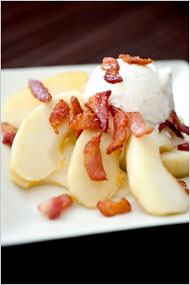
Photo by Evan Sung for The New York Times

After eating all of those kinds of things, though, you get to a point where you yearn for something a little different.  Well, famed chef and food writer, Mark Bittman, offers a suggestion in the New York Times for a dessert that fits the bill.

All you need is four ingredients: apples, sugar, ice cream and bacon.  Yeah, I'm writing about bacon again.  As Bittman writes, those of you who have either intentionally or mistakenly eaten bacon and maple syrup know, the smoke and salt of bacon goes great with sweet.  (It's one of my favorite combos--as I wrote in my post, "Make Me a Match" from October.

Bittman says to cook the bacon and then add sugar to give a crunchy, caramelization to the meat.  Cook the apple in the bacon fat with some more sugar and then serve with ice cream.  As he says, "I don't see this as a trend, but it's pretty great as a one-shot deal."  Read his article for more details on how to make this.  I'm going to have to try it soon.

Monday, November 8, 2010

Waste Not...

I have to pass along a link to a must-read article from the New York Times.  It's titled "From Farm to Fridge to Garbage Can" and it's about how much of the food we buy goes to waste. 

You can read the article, but just a few statistics that are amazing and alarming:
  • It's estimated that about 25% of the food produced in this country goes to waste--in the field, in transport, in the grocery store or at home.
  • A recent study shows that about 40% of this waste takes place at home.
  • In another study, 93% of the respondents said that they bought food that they never use.
  • If a family of four wastes 25% of the food they buy each week (at a cost of about $175), it means that they throw away over $40 worth of food each week.  That comes to about $2275 per year.  That's a lot of money.
  • Food waste makes up an estimated 19% of landfills in this country.  The food then rots, creating methane (a greenhouse gas) and hurts the environment.
As I jump on my soap box, I have to say that this is ridiculous!  Think of the amount of energy and time it takes to raise this food.  Think of the people all around the world who are dying of hunger.  We complain about the cost of food and then literally throw away a quarter of it.

How can we change our course?  The article mentions a lot of good ideas.  Here are some that they mention and some of my own:
  • Freeze meats that you aren't going to eat in a few days.
  • Don't be afraid of brown spots or blemishes on fruits and vegetables.  Most of them can be easily cut off, leaving the rest fine to eat.
  • Make soup--find a good basic recipe and use those carrots, onions, celery and whatever else is just past its prime.  They'll give whatever flavor they have left instead of being thrown away.
  • Plan your meals--buy just what you need to make those meals for the week.  Don't feel like you have to fill your fridge or buy something just because it's on sale.
  • Buy local.  Foods that are fresher, last longer.
  • Compost.  For those things that do get thrown away, at least use it to help your garden grow and renew the environment.
  • At the risk of tooting my own horn, get a personal chef to make your meals.  I buy just what is needed to make the meals I've planned.  I use fresh ingredients immediately after I buy them.  Very little wasted food = very little wasted money. 
This is a very serious problem, but one that we can all help to alleviate if we just use our heads.